
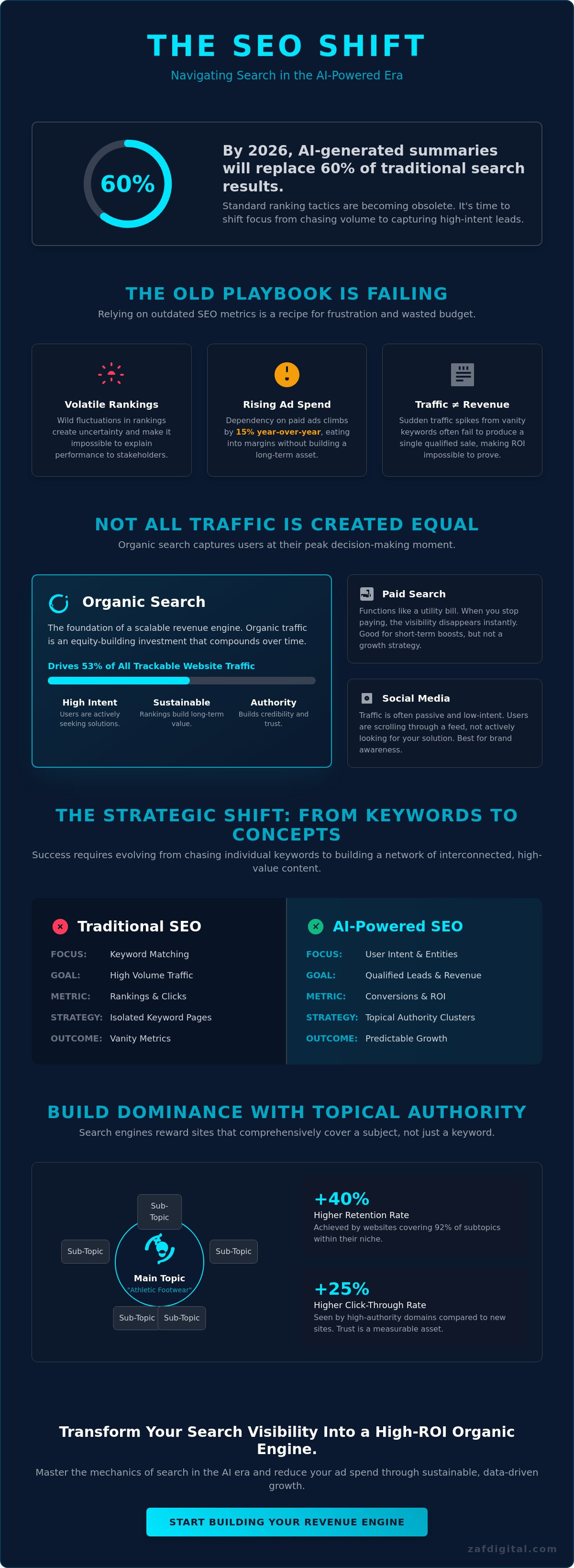
By 2026, 60% of traditional search engine results pages will be replaced by AI-generated summaries, making standard ranking tactics obsolete. This shift fundamentally changes how we view seo and traffic as a driver for real business revenue. If you're still chasing high-volume keywords without a specific conversion strategy, you're essentially building your digital presence on sinking sand.
You've likely felt the frustration of watching your rankings fluctuate wildly while your dependency on expensive Google Ads climbs by 15% year-over-year. It's exhausting to explain to stakeholders why a sudden traffic spike didn't lead to a single qualified sale. We agree that the old way of "more is better" is dead; today's winners focus on the specific intent of the lead rather than the total number of clicks.
This guide promises to give you a clear framework to transform your search visibility into a high-ROI organic engine. You'll learn how to master the mechanics of search in the AI era and reduce your ad spend through sustainable, data-driven growth. We'll explore the exact technical shifts and content strategies required to dominate your niche through the end of this decade.
Key Takeaways
• Understand how AI-driven search and entity-based SEO are replacing traditional keyword matching to define the future of organic visibility.
• Learn to distinguish between high-volume vanity metrics and conversion-intent queries to ensure your seo and traffic efforts lead to actual revenue.
• Discover a two-phase strategic framework for identifying competitive gaps and building undeniable topical authority through content clusters.
• Master the integration of search performance into a broader growth marketing engine to scale leads and automate your traffic analysis.
Understanding SEO and Traffic in the 2026 Digital Economy
Search engines no longer just provide lists; they provide answers. Traditional search results have been replaced by a hybrid of AI-generated overviews and hyper-targeted rich snippets. For high-growth companies, Search engine optimization (SEO) isn't a peripheral marketing tactic anymore. It's the foundation of a scalable revenue engine. The relationship between seo and traffic is defined by the compounding value of content that answers real questions and solves specific user problems.
To better understand how these fundamentals drive growth, watch this tutorial on ranking higher in search results:
Organic traffic represents the flow of users from unpaid search results to your digital assets. While paid ads offer immediate visibility, they function like a utility bill. You stop paying, the lights go out. SEO operates like an equity-building investment. In 2024, data from BrightEdge showed that organic search drove 53% of all trackable website traffic. By 2026, the quality of this traffic has only increased as AI filters out low-intent queries, leaving businesses with more qualified leads.
The Anatomy of an Organic Visit
Every organic visit starts with a trigger. A user enters a query, and the search engine's index evaluates billions of pages based on relevance and authority. Your content must satisfy the intent behind the query to earn a click. SEO traffic is the bridge between user intent and business solutions. Data from industry benchmarks indicates that high-authority domains see a 25% higher click-through rate on average compared to new sites. This proves that trust is a measurable business asset.
Organic Search vs. Other Traffic Channels
Social media traffic is often passive. Users aren't looking for you; they're scrolling through a feed. Direct and referral traffic are valuable but difficult to scale without existing brand recognition. SEO traffic is different because it captures users at the peak of their decision-making process. This creates a halo effect across your entire marketing mix. When your organic presence is strong, your paid search costs often drop because algorithms recognize your site as a high-quality destination. This synergy turns seo and traffic into a predictable growth lever that improves every other channel's ROI.
Higher Intent
Searchers are actively looking for solutions, leading to better conversion rates.
Sustainability
Organic rankings don't disappear when your monthly ad budget is spent.
Authority
Ranking on the first page builds immediate credibility that social ads can't replicate.
The Mechanics of Modern Organic Search: Beyond Simple Keywords
Search engines no longer scan for exact character matches. By 2026, Google and Bing have fully transitioned into sophisticated answer engines powered by Large Language Models. They interpret the underlying intent behind a query rather than just the words used. This evolution means seo and traffic strategies must prioritize entity-based optimization. An entity is a well-defined concept or object that search engines recognize. Instead of merely ranking for "best running shoes," you now need to establish topical authority across the entire "athletic footwear" ecosystem. Understanding how SEO works at this fundamental level is the first step toward building a sustainable organic engine.
Topical authority is a measurable metric based on how comprehensively you cover a specific subject. Data from early 2026 shows that websites covering 92% of subtopics within a niche saw a 40% higher retention rate than those focusing on isolated keywords. Search engines use AI to map relationships between your content and established facts. If your site lacks these logical connections, your visibility will stall. Success requires a shift from chasing volume to building a network of interconnected, high-value pages.
How AI Overviews and SGE Change the Traffic Landscape
AI Overviews have fundamentally altered user behavior. Zero-click searches reached a record 61% in the first quarter of 2026. To stay visible, your content must be the primary source for the AI's generated summary. This requires a dual approach where Technical SEO vs. Content SEO work together to ensure LLMs can easily parse and credit your data. Optimizing for AI crawlers involves using clear, declarative statements and structured lists that machines can digest instantly. Visibility now depends on being cited within the AI snapshot itself.
The Role of Technical Infrastructure
Technical foundations act as the engine for your digital presence. Site speed and mobile-first indexing are non-negotiable for traffic retention. A 150ms delay in Largest Contentful Paint (LCP) can result in a 9% drop in user engagement. Use Schema markup to provide search engines with a clear map of your data, covering everything from product availability to author credentials. Technical SEO is the floor that keeps you in the game, while content is the ceiling that determines your growth. Long-term seo and traffic success depends on this synergy. If you're looking to identify gaps in your strategy, you can partner with our growth experts to audit your technical stack.
Evaluating Traffic Quality: Why All Organic Visits Are Not Created Equal
Raw numbers often lie. A site can boast 50,000 monthly visits and still struggle to meet revenue targets if that traffic consists of digital window shoppers. We call these vanity metrics. They look impressive in a slide deck but don't impact the bottom line. To build a high-ROI engine, you must distinguish between high-volume informational queries and high-intent commercial searches. Your seo and traffic strategy should prioritize the latter to ensure every click has a clear path to a transaction.
Using Google Analytics 4 (GA4) is mandatory for tracking business value. Instead of looking at total sessions, we analyze "Key Events" and "Conversion Paths." This data reveals which specific blog posts or landing pages lead to a lead form submission or a checkout. If a page has high traffic but zero conversions, it's a drain on your crawl budget. We focus on qualified traffic: users who have the specific pain point your business solves and the budget to fix it. Data from early 2024 shows that 80% of top-performing sites now prioritize "conversion-intent" over raw session volume.
Mapping Traffic to the Buyer Journey
Every search query sits at a specific stage of the funnel. Top-of-Funnel (TOFU) traffic focuses on awareness. These users aren't ready to buy; they're solving initial problems or seeking definitions. Middle-of-Funnel (MOFU) and Bottom-of-Funnel (BOFU) traffic is where the revenue lives. These users compare solutions and look for "best-in-class" providers. You can identify these high-value patterns in Search Console by filtering for keywords containing "versus," "pricing," or "services." Capturing a user at the BOFU stage often leads to a 300% increase in lead quality compared to broad informational terms.
Bounce Rate and Engagement: The Quality Signals
High bounce rates are a loud signal to search engines that your content failed the user. If visitors leave within seconds, it suggests your site didn't fulfill their search intent. Improving dwell time requires more than just long text; it demands high conversion web design that guides the eye and reduces friction. Technical excellence is also a major factor. As highlighted in Michigan Tech's SEO Ranking Guide, maintaining fast site speed and mobile responsiveness is essential for keeping users engaged. Use strategic internal linking to keep traffic circulating within your ecosystem. Don't let a visit end on a single page; provide a clear next step to move them deeper into your brand's world. This approach ensures your seo and traffic efforts result in a loyal audience rather than a one-time bounce.
A Strategic Framework for Increasing Sustainable Organic Traffic
Scaling organic results requires a structured roadmap. We break this down into five distinct phases designed to turn search engines into predictable revenue drivers. This isn't about chasing temporary spikes; it's about building a machine where seo and traffic align with your bottom line.
Phase 1
Deep competitive gap analysis. We identify where competitors are over-leveraged and pinpoint keywords that can deliver a 15% traffic boost within the first 90 days.
Phase 2
Content cluster development. We group related topics to prove to search engines that you own the entire subject matter, establishing undeniable topical authority.
Phase 3
Technical optimization. We audit the infrastructure to ensure 100% crawlability and rapid indexation of new assets.
Phase 4
Authority building. We use strategic digital PR to earn backlinks from high-authority domains, moving beyond outdated link-building tactics.
Phase 5
Continuous testing. We refine the strategy based on real-time performance data, adjusting for algorithm shifts every 30 days.
Conducting a Modern SEO Audit
Your growth is only as strong as your foundation. A comprehensive SEO audit Dubai is the mandatory first step for regional dominance. We don't just look at metadata. We identify broken links, crawl errors, and content decay that might be dragging down your rankings. Most sites see a 25% improvement in visibility just by fixing technical debt. We set realistic benchmarks for the first 6 to 12 months, focusing on compounding gains rather than overnight miracles.
Content Strategy for 2026: Quality Over Clicks
The "Helpful Content" standard is the law of the land. You must write for humans first and algorithms second. In 2026, search engines prioritize expert-led insights over generic AI-generated filler. Integrating a video marketing strategy is essential to capture the growing "Video Tab" search volume, which has increased by 40% in mobile search results over the last year. Use AI tools to accelerate your research, but ensure every word reflects your brand's unique expertise. This balance is how you win the battle for seo and traffic.
Ready to build a high-ROI organic engine? Partner with ZAF Digital to scale your growth.
Scaling Your Traffic into Revenue: The ZAF Digital Performance Approach
Traffic is a vanity metric if it doesn't hit your bank account. Many agencies focus on "green arrows" in a report, but at ZAF Digital, we treat seo and traffic as the raw fuel for a much larger engine. We integrate search optimization into a broader growth marketing framework where every click is mapped to a customer journey. It's not about being seen; it's about being chosen.
Our methodology leverages AI transformation to eliminate the guesswork. We use automated analysis to identify which search patterns lead to high-value conversions and which are just "noise." By the time a lead interacts with your site, our systems have already analyzed their intent. We even automate lead follow-up processes to ensure that organic interest doesn't go cold. In the fast-paced Dubai market, a delay of even 30 minutes can decrease conversion rates by 21%.
We've moved past simple traffic reports. Our partners receive revenue attribution models. We show you exactly which content pieces generated the most profit, not just the most hits. This level of transparency is essential for businesses operating across international borders where market dynamics shift weekly. We understand the specific cultural and commercial nuances of the UAE, ensuring your brand resonates locally while competing globally.
Performance SEO: The ROI-First Mindset
We don't care about ranking for keywords that don't convert. Our focus remains fixed on the metrics that move your bottom line. This means providing no-bullshit data. If a strategy isn't working, we tell you, and we pivot. We prioritize transparency because trust is built on results, not polished presentations.
Consider our work with a local Dubai service provider. By refining their seo and traffic strategy to target high-intent "near me" queries and optimizing their conversion funnels, we saw a 142% increase in qualified leads within five months. We didn't just get them more visitors; we got them more customers. That is the ZAF Digital difference.
Next Steps: From Education to Execution
The risks of waiting are quantifiable. Every day you operate without a sophisticated organic strategy, you're ceding market share to competitors who are already optimizing for 2026. Ad-dependency is a trap. When you stop paying for ads, your traffic vanishes. Organic authority, however, is an asset that appreciates over time.
• Stop renting your audience from Google and Meta.
• Start building an organic engine that works 24/7.
• Transition from unpredictable ad spend to scalable organic growth.
The shift from dependency to authority starts with a single decision. Contact ZAF Digital for a performance-driven SEO strategy and let's turn your search presence into a revenue-generating powerhouse.
Future-Proof Your Growth Engine
Success in the 2026 search landscape requires a shift from broad visibility to surgical precision. You've seen how the integration of AI-powered optimization and intent-based mapping transforms raw data into a competitive advantage. According to Gartner, search engine volume is projected to decline by 25% by 2026 because of AI chatbots, which means your strategy for seo and traffic must prioritize high-intent users over mere click counts. It's not about being seen by everyone; it's about being found by the right people at the exact moment they're ready to buy.
ZAF Digital brings Dubai-based expertise and a global reach to your marketing stack. We don't believe in vanity metrics or empty promises. Instead, we leverage AI-powered marketing innovation and a rigorous, data-driven ROI focus to ensure every organic visit contributes to your bottom line. We act as your strategic partner, treating your growth as our own. Our approach ensures your business isn't just surviving the shifts in the digital economy but actively leading the way.
Stop chasing clicks and start driving revenue; work with ZAF Digital
The digital market moves fast, but with the right framework, your brand's authority will only grow stronger.
Frequently Asked Questions
How long does it take to see an increase in SEO traffic in 2026?
Most businesses see a measurable increase in seo and traffic within 4 to 9 months of implementing a consistent strategy. While technical fixes might show results in 30 days, ranking for competitive keywords in 2026 requires building topical authority over several quarters. Data from Ahrefs shows only 5.7% of newly published pages reach the top 10 within a year. Success isn't instant; it's a cumulative process of proving your site's value to search algorithms.
Will AI search engines like ChatGPT and Google SGE kill traditional SEO traffic?
AI search engines won't kill traffic, but they'll definitely redistribute it. Google's Search Generative Experience (SGE) satisfies 40% of informational queries directly on the results page. This means you'll lose "vanilla" clicks while gaining higher-intent visitors who need deep, expert analysis that AI can't replicate. Brands that focus on "Information Gain" and unique data will maintain a steady flow of organic visitors despite the rise of AI summaries.
Is organic traffic really 'free' if I have to pay for an agency or content?
Organic traffic isn't free; it's an earned asset with a lower long-term cost than paid ads. While you'll invest in high-quality content and technical optimization, the cost per lead usually drops by 60% compared to PPC after the first year. Think of it as buying a home instead of renting. You're building equity in your digital footprint that keeps generating leads even if you pause your monthly spending.
What is the difference between organic traffic and paid search traffic?
Organic traffic comes from unpaid search results based on relevance, while paid search involves bidding on keywords to appear in sponsored slots. Paid ads offer immediate visibility but disappear the moment you stop paying. Organic results provide 24/7 visibility and generally earn 70% to 80% of all search engine clicks. A balanced strategy uses paid for quick wins and organic for sustainable, compounding growth.
How do I know if my SEO traffic is actually leading to sales?
You track sales by setting up conversion events in Google Analytics 4 (GA4) and using multi-touch attribution models. Don't just look at "last-click" sales. Data shows organic search often assists in 3 to 5 touchpoints before a customer finally converts. By tagging your URLs and monitoring the "Path Exploration" report, you can see exactly how seo and traffic contribute to your bottom-line revenue.
Can I increase my SEO traffic without a massive blog or content library?
You can grow your traffic by optimizing existing high-intent pages instead of churning out new blog posts. Improving the page speed of your top 10 landing pages can increase conversion rates by 20% according to Portent's research. Focus on "Zero-Volume" keywords that target specific buyer pain points. Quality beats quantity every time in 2026, especially when you prioritize technical health and user experience over sheer page count.
Why is my organic traffic dropping even though my rankings stay the same?
Your traffic might drop because of "zero-click" searches or changes in user behavior. If Google places an AI overview or a local map pack above your #1 ranking, your click-through rate can plummet by 30% or more. Seasonality also plays a role. If the total search volume for your industry dips in December, your rankings will hold steady while your actual visitor numbers decline.