

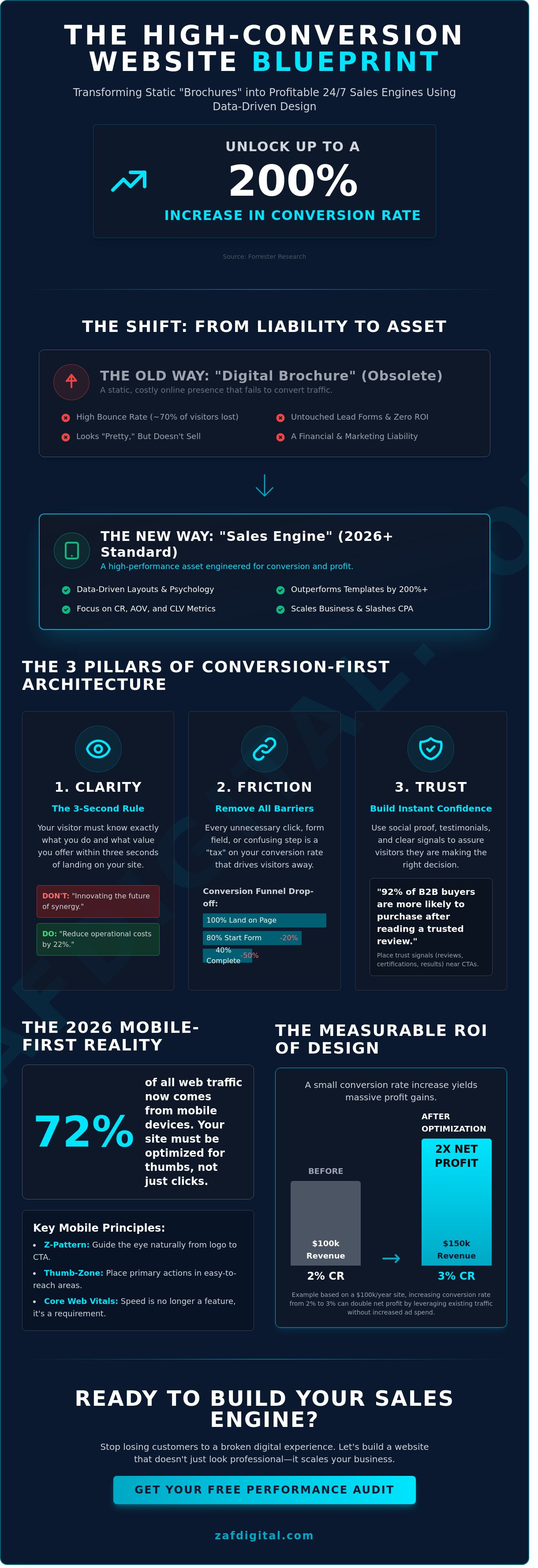
Did you know that a strategic shift toward high conversion web design can increase your site's conversion rate by up to 200%? According to research from Forrester, the difference between a "pretty" site and an effective one isn't just aesthetic; it's a measurable impact on your bottom line. You've likely felt the frustration of seeing healthy traffic numbers in your analytics while your lead forms remain untouched. It's exhausting to pay for expensive clicks only to watch 70% of visitors bounce within seconds because your site feels like a static digital brochure rather than a dynamic sales tool.
We're here to bridge that gap. This guide will show you how to transform your website into a high-performance sales machine using behavioral science and the data-driven design principles set to dominate 2026. You'll discover the exact psychological triggers that turn skeptical visitors into loyal customers while significantly improving your marketing ROI. We'll provide a clear, actionable framework for building a site that doesn't just look professional but actually scales your business through measurable results.
Key Takeaways
• Learn why the traditional "digital brochure" model is obsolete and how to replace it with a strategic, ROI-driven sales architecture.
• Discover how to apply behavioral science principles like Hick’s Law to eliminate user friction and drive decisive visitor action.
• Master the 3-second value proposition rule to implement high conversion web design that instantly resonates with your target audience.
• Understand why Core Web Vitals 4.0 and mobile "thumb-zone" optimization have evolved into essential business performance metrics.
• Identify hidden leaks in your current funnel through a data-driven audit process that integrates SEO, PPC, and UX into one growth engine.
What is High-Conversion Web Design?
High-conversion web design isn't about artistic flair or chasing the latest aesthetic trends. It's the calculated intersection of user experience (UX), behavioral psychology, and aggressive business growth. By 2024, the "Digital Brochure" model officially died. Businesses realized that a static online presence is a liability that costs money rather than a tool that makes it. Today, your website must function as a 24/7 sales engine that anticipates user needs before they even articulate them.
The fundamental difference between a "pretty" site and a "profitable" site lies in the intent behind every pixel. A pretty site wins design awards; a profitable site wins market share. Success in this discipline is measured through hard data rather than subjective opinions. We focus on three core pillars: Conversion Rate (CR), Average Order Value (AOV), and Customer Lifetime Value (CLV). According to 2024 industry benchmarks, sites built with a focus on Conversion marketing principles outperform generic templates by 200% or more in lead generation efficiency.
The ROI of Strategic Design
Small shifts in performance yield massive bottom-line results. If your site generates $100,000 in revenue with a 2% conversion rate, increasing that rate to 3% doesn't just add a few sales. It can effectively double your net profit by leveraging your existing traffic without increasing your ad spend. This approach to high conversion web design also slashes your cost-per-acquisition (CPA) on platforms like Google and Meta. When your landing pages are optimized, every dollar spent on advertising works harder. Professional interface standards aren't just about looks; they build the immediate trust necessary to move a cold lead to a closed deal.
The 2026 Standard: Beyond the Landing Page
The era of the "About Us" page being a dead end is over. In 2026, every single URL on your domain must have a primary conversion goal. We no longer look at the macro-conversion alone. We track micro-conversions, such as newsletter signups, whitepaper downloads, or specific video playbacks, to map the entire buyer journey. At ZAF Digital, we don't view web design as a standalone creative project. It's a critical component of performance marketing. High conversion web design requires a "no-bullshit" approach to data. If a design element doesn't contribute to a measurable goal, it's clutter that needs to be removed. We treat your website as a living laboratory where every update is an opportunity to scale your results.
Data-Driven Layouts
Using heatmaps to place CTA buttons where users actually click.
Psychological Triggers
Implementing scarcity and social proof at the exact moment of decision-making.
Frictionless UX
Removing every unnecessary form field to prevent user drop-off.
The 3 Pillars of Conversion-First Architecture
Effective high conversion web design isn't an accident. It's the result of a rigorous, data-driven framework that prioritizes user psychology over purely aesthetic choices. By 2026, the average mobile user spends less than 50 seconds deciding whether a service meets their needs. This means your architecture must do the heavy lifting before the user even begins to scroll. We build sites that function as silent sales machines, guiding visitors toward a specific action without creating mental fatigue.
The F-pattern and Z-pattern remain the gold standards for visual hierarchy in a mobile-first world. On mobile devices, which now account for 72% of all web traffic, the Z-pattern guides the eye from the logo to the menu, then across the hero image to the primary call to action. We don't just place buttons; we map them to the natural movements of the human eye. Trust signals, such as real-time client results or verified industry certifications, must be woven into these patterns. Don't hide your social proof on a separate page. Since 92% of B2B buyers are more likely to purchase after reading a trusted review, we place these signals directly where the friction is highest.
Clarity: The 3-Second Rule
Your visitor should know exactly what you do within three seconds. Most businesses fail here because they use "clever" metaphors instead of clear outcomes. Don't tell them you're "innovating the future of synergy." Tell them you "reduce operational costs by 22% through automated logistics." We focus on headlines that highlight the end result. Hero imagery shouldn't just look pretty. It needs to mirror the visitor's desired emotional state. High-impact design removes cognitive load by stripping away technical jargon that confuses the buyer's brain.
Friction: Removing the Barriers to Entry
Every extra field in a contact form acts as a tax on your conversion rate. Data shows that reducing form fields from five to three can boost completions by up to 66%. We follow a "One Page, One Goal" philosophy. If a page exists to generate leads, every element on that page must serve that single objective. Distractions like excessive footer links or competing CTAs only serve to dilute the user's intent. You can use these landing page a/b testing ideas to pinpoint exactly where your users are dropping off. If you're ready to stop guessing and start growing, you can partner with our strategy team to rebuild your conversion funnel from the ground up.
Behavioral Psychology: Why Visitors Click (or Leave)
Design without psychology is just art. For a site to generate revenue, it must align with how the human brain processes information. We focus on Hick’s Law, which states that the time it takes to make a decision increases with the number and complexity of choices. If your homepage offers ten different paths, you aren't being helpful; you're creating "analysis paralysis." Data from 2025 user behavior studies shows that reducing menu items from seven to five can increase goal completion by up to 22%.
We also leverage the Zeigarnik Effect. Humans have a psychological drive to finish what they start. By using visible progress bars in multi-step forms or checkout processes, we tap into this "incomplete task" tension. Sites using progress indicators see a 30% higher completion rate compared to those with single, overwhelming pages. It's about momentum. High conversion web design thrives on these subtle psychological nudges that guide a user from curiosity to commitment without friction.
Social Proof 2.0 has moved past the era of "Great service!" quotes. In 2026, buyers demand verification. We replace generic testimonials with data-backed micro-case studies. Showing a "14% increase in efficiency over 6 months" carries more weight than a hundred vague five-star reviews. Many founders worry that a conversion-focused site will hurt their brand identity. This is a myth. Conversion is the highest form of brand utility. A site that helps a user solve a problem quickly and elegantly strengthens your brand far more than a slow, "artistic" site that confuses them.
Cognitive Biases in Web Design
We use the Scarcity Principle by integrating real-time data feeds, such as "only 3 spots left for this quarter," to drive immediate action. In the UAE market, Authority Bias is a massive lever. Positioning your brand as the "Safe Choice" through local certifications or partnerships with entities like the Dubai Chamber of Commerce builds instant trust. Finally, we use Anchoring. By presenting a premium solution first, the standard option becomes the logical, high-value choice for the buyer.
The Role of AI in Personalization
Static websites are becoming obsolete. Modern high conversion web design uses dynamic content that shifts based on whether a visitor arrived from a LinkedIn ad or a direct search. Integrating an ai chatbot for business allows your site to answer specific objections in real-time, effectively acting as a 24/7 sales closer. This is paired with Predictive UX, where we use historical data to anticipate the user’s next click, pre-loading the content they need before they even realize they want it.
The 2026 Conversion Checklist: From Speed to Mobile-First
By 2026, the boundary between technical SEO and user experience has effectively vanished. Core Web Vitals 4.0 makes this clear. Largest Contentful Paint (LCP) and Interaction to Next Paint (INP) aren't just metrics to please search engines; they're direct predictors of your bottom line. If your site takes longer than 2.5 seconds to render its main content, you've already lost 30% of your potential leads. We treat these numbers as the heartbeat of modern conversion because they dictate whether a user stays or bounces before your value proposition even loads.
Visual hierarchy in 2026 focuses on cognitive ease. We use size, weight, and color contrast to create a frictionless eye path that leads directly to your goal. This isn't about aesthetics. It's about directing human psychology. Accessibility serves as a massive conversion lever in this landscape. By following WCAG 2.2 standards, you aren't just being inclusive; you're opening your doors to the 15% of the global population living with some form of disability. Inclusive high conversion web design ensures that every visitor, regardless of their hardware or physical ability, can complete a purchase without barriers.
Technical Performance as a Sales Tool
The 100ms rule is the gold standard for ROI-focused brands. Research from Deloitte indicates that a mere 0.1 second improvement in mobile load speed can lift retail conversion rates by 8.4%. We utilize server-side rendering (SSR) and edge caching to ensure global performance remains consistent. Core Web Vitals are the heartbeat of modern conversion, reflecting the stability and responsiveness that users demand. When your site reacts instantly, it builds a level of subconscious trust that no marketing copy can replicate. High-performance infrastructure is the silent closer on your sales team.
Mobile Optimization Strategy
In Dubai’s mobile-heavy market, where smartphone penetration sits above 96%, designing for the "thumb-zone" is mandatory. We move away from top-heavy navigation to bottom-aligned menus and sticky CTAs that sit exactly where the user's hand rests. Your mobile checkout is likely the biggest hole in your revenue bucket. Reducing form fields from five to three and implementing one-tap biometric payments can increase completion rates by 35% based on 2025 transaction data. We also optimize load sequences to distinguish between 5G and public Wi-Fi, ensuring your high conversion web design remains functional even in low-bandwidth environments.
The ZAF Digital Approach: Performance-First Web Design
At ZAF Digital, we don't build digital brochures. We build revenue engines. Our philosophy centers on high conversion web design where SEO, PPC, and UX operate as a single, synchronized system. Most agencies treat these as separate silos, but that's exactly how conversion leaks happen. If your PPC landing page doesn't align with your organic SEO structure or your UX flow, you're burning your marketing budget. We ensure every pixel serves a specific business goal.
We start every partnership with our "No-Bullshit" audit. We don't look for subjective aesthetic flaws; we look for friction. Using quantitative data, we identify exactly where users drop off. In 2024, our audits revealed that 65% of mid-sized B2B sites lose potential leads due to technical debt or confusing navigation. We find these leaks and plug them. We also build for the future. Your site must be ready for the AI transformation, meaning it needs clean data structures and scalable architecture that can handle dynamic, personalized content.
Our results speak through the data. For a Dubai-based luxury real estate brand, we moved beyond surface-level changes. By implementing a structural redesign focused on intent-based navigation and mobile-first speed, we tripled their monthly lead volume within 120 days. We didn't just make it look better; we re-engineered how they capture value.
Data-Driven Iteration
A "launch and leave" strategy is a recipe for failure. The digital market moves too fast for static thinking. We use heatmaps and session recordings to validate every design choice we make. If users ignore your primary CTA, we move it. If they struggle with a mobile form, we simplify it. The ZAF Digital 90-day optimization cycle ensures your site stays ahead of market shifts and competitor moves. We rely on evidence, not intuition.
Ready to Scale Your Conversions?
The transition from a static site to an AI-powered growth platform is the biggest competitive advantage you can gain this year. It starts with a clear understanding of your current performance gaps. Stop guessing why your visitors aren't converting and start making data-backed decisions. It's time to move past mediocre results. Transform your website into a conversion machine with ZAF Digital and secure your ROI for 2026 and beyond.
Future-Proof Your Digital Revenue Today
Building a website in 2026 isn't just about aesthetics; it's about engineering a high-performance revenue engine. We've explored how behavioral psychology and technical precision dictate user actions. Industry data from 2024 reveals that 88% of online consumers won't return to a site after a single poor experience. This makes high conversion web design a non-negotiable asset for scaling your brand. At ZAF Digital, our Dubai-based performance experts leverage AI-integrated design frameworks to ensure every pixel serves a measurable business goal. We don't just build pages; we create strategic assets focused on documented ROI. You've seen the pillars and the 2026 checklist. Now, it's time to apply these insights to your own platform. Don't let your competition capture the market share that belongs to you. Our team is ready to analyze your current performance and identify the specific leaks in your sales funnel.
Book your free Conversion Audit with ZAF Digital today
Let's turn your digital presence into your most powerful growth tool.
Frequently Asked Questions
What is a good conversion rate for a business website in 2026?
In 2026, a healthy conversion rate for most B2B industries sits between 3% and 5%. If your site hits above 11%, you're in the top 10% of your niche globally. We focus on high conversion web design to push past these averages by removing friction in the user journey. Don't settle for the 2.35% industry median when data-driven adjustments can double your lead flow.
How long does it take to see results from a high-conversion redesign?
You'll typically see measurable shifts in user behavior within 30 days of launching a redesign. Significant ROI data usually matures by the 90-day mark once enough traffic has passed through the new funnels. We use A/B testing to validate these changes quickly; it's not about guessing, it's about watching the numbers climb month over month. Consistency in tracking is what turns a launch into a growth engine.
Does high-conversion web design affect my SEO rankings?
Yes, high conversion web design directly improves your SEO rankings by optimizing for Google's Core Web Vitals. Sites that load in under 2 seconds see a 50% lower bounce rate than slower competitors. When users stay longer and interact more, search engines recognize your site as high value. This synergy between UX and SEO ensures you don't just get traffic; you keep it and turn it into revenue.
Can I optimize my existing site or do I need a total redesign?
You can often achieve a 15% lift through incremental Conversion Rate Optimization (CRO) without a full rebuild. However, if your underlying architecture is more than 3 years old, a total redesign is usually more cost effective. Legacy code often limits your ability to implement modern tracking and AI features. We analyze your current data to decide if a patch or a pivot serves your ROI better.
How much does a high-conversion web design project cost in Dubai?
Professional web design costs in the UAE market vary based on complexity, with custom business sites typically ranging from 18,000 AED to 75,000 AED. High-end enterprise solutions requiring complex integrations can exceed 150,000 AED according to 2024 industry benchmarks. We don't provide flat estimates because every growth strategy is unique. Your investment should always be weighed against the projected increase in your customer lifetime value and lead quality.
How do AI chatbots improve website conversion rates?
AI chatbots can increase lead generation by up to 40% by providing instant responses 24/7. Modern LLM-based bots handle complex queries that old rule-based systems couldn't touch. They qualify leads in real time, so your sales team only talks to high-intent prospects. This automation ensures no visitor leaves because they couldn't find a simple answer at 2 AM. It's about being available exactly when the customer is ready to buy.
What are the most important trust signals for a UAE-based audience?
For the UAE market, displaying a local physical address and a visible WhatsApp Business button are the top trust drivers. Including local licensing details or the "Made in UAE" mark can increase trust by 25% among regional buyers. Testimonials from recognizable local brands also carry more weight than international logos. These specific signals prove you're a legitimate player in the local ecosystem and understand the regional business culture.
Is mobile-first design still relevant for B2B companies?
Mobile-first design is mandatory, as over 50% of B2B search queries now happen on smartphones. Even if your final checkout happens on a desktop, the initial discovery and research phases are mobile-driven. If your site doesn't function perfectly on a mobile device, you're losing half your potential leads before they even reach their office. We build for the palm of the hand first to capture intent the moment it strikes.