
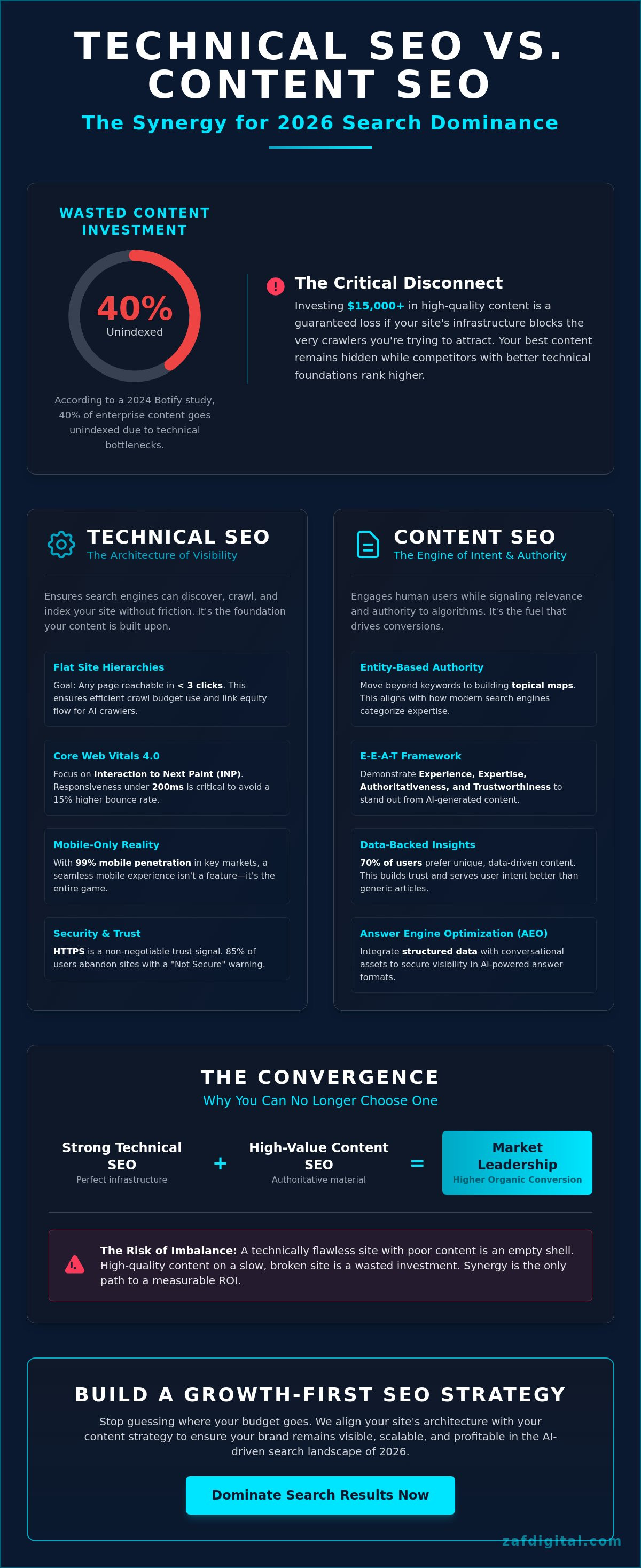
Investing $15,000 in high-quality content is a guaranteed loss if your site's infrastructure blocks the very crawlers you're trying to attract. According to a 2024 Botify study, 40% of enterprise website content goes unindexed due to technical bottlenecks. You likely know the frustration of seeing a meticulously researched 3,000-word guide sit on page five of Google while a competitor's thinner post ranks higher. This friction usually stems from a misunderstanding of technical seo vs content seo and how they must evolve together to survive the 2026 search landscape.
It's time to stop guessing where your budget goes. You'll discover the critical differences between these two pillars and learn how to balance them to dominate search results in 2026. This article provides a clear roadmap for your SEO investment, showing you how the synergy between code and content drives higher organic conversion rates. We're moving past the "content is king" myth to look at the data-driven reality of modern search visibility. We'll examine exactly how to align your site architecture with AI-driven search intent to ensure your brand remains visible, scalable, and profitable.
Key Takeaways
• Master the shift to flat site hierarchies and Core Web Vitals 4.0 to ensure your infrastructure meets the evolving demands of 2026 AI crawlers.
• Transition from simple keyword targeting to entity-based authority to better align your material with how modern search engines categorize topics and user intent.
• Understand the vital synergy of technical seo vs content seo to ensure technical bottlenecks don't destroy the ROI of your high-quality content.
• Learn to integrate structured data with conversational assets to secure visibility in the emerging landscape of Answer Engine Optimization (AEO).
• Apply a growth-first audit framework to identify and prioritize the specific optimizations that will drive the fastest measurable results for your business.
Technical SEO vs. Content SEO: Defining the Pillars of Growth
Organic growth in 2026 demands a perfect synergy between machine-readability and human value. The debate of technical seo vs content seo often frames them as opposing forces, but they're actually two sides of the same coin. At ZAF Digital, we treat these pillars as the non-negotiable baseline for any performance marketing strategy. Without a solid technical setup, your best content stays hidden. Without high-value content, your technical perfection is a waste of server space. Understanding the fundamentals of Search Engine Optimization (SEO) is the first step toward building a scalable digital presence that generates a measurable ROI.
To better understand how these two disciplines interact to drive your rankings, watch this helpful breakdown:
The 2026 perspective is clear; the gap between code and words is closing. Search engines now use sophisticated LLMs to evaluate how site architecture supports semantic meaning. This means your infrastructure must be as "smart" as your copy. We don't settle for "good enough" metrics. We push for technical precision that enables content to scale.
What is Technical SEO?
Technical SEO focuses on the back-end infrastructure. It ensures search engines can discover, crawl, and index your site without friction. Core components include site speed, mobile-first indexing, and secure HTTPS protocols. Think of it as the foundation of a building. You can't build a skyscraper on shifting sand. If your Interaction to Next Paint (INP) scores lagged behind the March 2024 industry standards, your content won't rank, regardless of its quality. We focus on crawl budgets and schema markup to ensure bots interpret your data accurately.
What is Content SEO?
Content SEO is the front-end strategy. It's about engaging the human user while signaling relevance to algorithms. This pillar relies on keyword research, topical authority, and the E-E-A-T framework: Experience, Expertise, Authoritativeness, and Trustworthiness. Content is the fuel that drives the engine. In a landscape where AI-generated fluff is everywhere, 70% of users still prefer articles that provide unique, data-backed insights. We build topical maps that establish your brand as a leader, ensuring every word serves a specific conversion goal. The technical seo vs content seo balance is what separates stagnant sites from market leaders.
Technical SEO: The Architecture of Visibility in 2026
Technical SEO isn't just a backend chore; it's the framework that allows AI to interpret your brand's digital existence. While the debate of technical seo vs content seo often treats them as separate pillars, the reality is that your content is invisible without a stable foundation. In 2026, site architecture has shifted toward ultra-flat hierarchies. If a crawler needs more than three clicks to reach a page, that page effectively doesn't exist for modern AI search engines. Flat structures ensure that link equity flows efficiently and bots can map your site's relevance in seconds.
User experience metrics have evolved. Google's Core Web Vitals 4.0 now prioritizes Interaction to Next Paint (INP) as the primary indicator of site health. It's not enough for a page to load fast; it must be responsive. Sites that fail to process user inputs in under 200 milliseconds see a 15% higher bounce rate on average. This is especially vital in high-speed markets like Dubai, where mobile penetration sits at 99%. We've moved beyond mobile-first strategies into a mobile-only reality. If your site doesn't offer a desktop-equivalent experience on a smartphone, your rankings will stagnate regardless of your content quality.
Security remains the non-negotiable baseline. An SSL certificate is no longer a "pro" feature; it's a requirement for entry. Data shows that 85% of users abandon a site immediately if they see a "Not Secure" warning. A secure environment protects your data and acts as a trust signal that search engines use to verify your legitimacy. If you want to scale your infrastructure, partner with a team that treats technical health as a growth driver.
Structured Data and Schema Markup
Schema is the translator between human language and machine code. In the era of Search Generative Experience (SGE), AI agents don't just "read" your site; they extract facts. Implementing JSON-LD for local SEO, product availability, and FAQ snippets allows these agents to pull your data directly into the search results. This technical precision ensures your business context is understood perfectly, turning raw information into rich snippets that drive higher click-through rates than standard blue links.
Crawlability and Index Management
Optimizing your crawl budget is essential for maintaining a competitive edge. A lean robots.txt file and a dynamic XML sitemap prevent bots from wasting energy on low-value pages. Managing 404 errors and implementing 301 redirects is critical for preserving 100% of your hard-earned link equity. Technical debt accumulates quickly, so proactive monitoring is required. You can use The Ultimate SEO Audit Dubai Checklist to identify hidden technical blockers that might be hindering your organic performance. Balancing technical seo vs content seo starts with ensuring every page you publish is actually accessible to the machines that rank them.
Content SEO: The Engine of Intent and Authority
Content SEO has evolved from simple keyword placement into a sophisticated system of entity-based relevance. Modern search engines don't just look for words; they map relationships between concepts. Google’s Knowledge Graph now manages over 800 billion facts, meaning your strategy must focus on topics rather than isolated phrases. If your site doesn't define its entities clearly, you're invisible to the algorithm. Success in the technical seo vs content seo balance requires understanding that while technical health gets you invited to the race, content is what actually wins it.
Satisfying search intent is the non-negotiable foundation of growth. A 2024 analysis of 4 million search results showed that pages misaligned with intent saw a 60% drop in rankings within 90 days. Your content must serve one of four specific purposes:
Informational
Answering "how-to" or "what is" questions to build top-of-funnel awareness.
Navigational
Helping users find a specific brand or location.
Commercial
Providing comparisons and reviews for users in the consideration phase.
Transactional
Streamlining the path to purchase with clear calls to action.
Building topical authority is more effective than chasing a single viral hit. Data from HubSpot confirms that businesses publishing 16 or more posts per month generate 3.5 times more traffic than those publishing fewer than four. This volume creates a "moat" of expertise that competitors can't easily bridge. Additionally, content isn't a "set and forget" asset. Refreshing declining pages can boost organic traffic by 106%, making content maintenance a high-ROI activity for any scaling brand.
Mastering Semantic SEO and Clusters
Effective content architecture uses pillar pages to anchor broad topics, supported by specific "satellite" articles that target long-tail queries. This structure allows you to distribute internal link equity efficiently, signaling to crawlers which pages hold the most weight. Semantic clusters prove niche expertise by demonstrating a comprehensive understanding of a subject's interconnected subtopics rather than just targeting isolated search terms.
Optimizing for E-E-A-T in the AI Era
As AI-generated text floods the web, "Experience" has become the most valuable component of the E-E-A-T framework. Google prioritizes content that proves first-hand involvement. Use original data, 2025 case studies, and direct expert quotes to differentiate your brand from generic synthetic output. High-quality, human-led content doesn't just improve your technical seo vs content seo metrics; it builds a recognizable brand identity that drives direct traffic and long-term loyalty. When 70% of B2B buyers consume at least three pieces of content before talking to sales, your authority is your strongest conversion tool.
The Convergence: Why You Can No Longer Choose One
The feedback loop between infrastructure and information is now absolute. A 100 millisecond delay in page load can reduce conversion rates by 7 percent, effectively neutralizing any investment in high-quality copywriting. When we analyze technical seo vs content seo in 2026, we see they've merged into a single growth engine. Great content requires a high-performance stage to perform. If your site is slow, your ROI on content production dies before the first paragraph loads.
Google now uses technical signals to verify content quality through a process of cross-referencing. With the rise of Answer Engine Optimization (AEO), structured data provides the essential context that conversational AI needs to trust your claims. If your schema markup doesn't perfectly align with your on-page headers, search engines view the discrepancy as a lack of authority. In 2026, technical signals act as the digital notary for your content's credibility.
From a performance marketing perspective, silos in your SEO team lead to stagnant revenue. When developers and content creators work in isolation, they miss the 22 percent average traffic lift seen by integrated teams. Success requires a unified strategy where technical health supports content reach.
Myth-Busting: 'Technical SEO is a One-Time Fix'
Algorithm updates now occur with higher frequency than in previous years. A site that was technically sound in 2024 might fail modern Core Web Vitals in 2026 due to updated rendering standards. Modern frameworks like React or Next.js offer incredible speed but require precise server-side rendering (SSR) configurations to remain indexable. ZAF Digital manages ongoing technical health for scaling brands because a single unoptimized script can tank a year of organic growth. Continuous monitoring is the only way to maintain a competitive edge.
Myth-Busting: 'Content is King, Regardless of Tech'
Content is only king if it's visible. We've audited sites where 40 percent of the blog posts were 'invisible' to crawlers due to JavaScript execution errors. This is the danger of prioritizing technical seo vs content seo as an 'either-or' choice. Poor user experience (UX), characterized by layout shifts or slow interaction times, triggers high bounce rates. These signals tell Google your content isn't valuable, even if the writing is flawless. You must align your web design with SEO requirements from the first line of code.
Stop treating your website's health and its message as separate entities. Siloed strategies result in wasted budgets and missed targets. Partner with ZAF Digital to unify your SEO strategy and drive measurable business growth through a converged approach.
Building a Growth-First SEO Strategy with ZAF Digital
The debate over technical seo vs content seo often misses the point; they are two sides of the same coin. At ZAF Digital, we don't treat them as separate silos. We start every partnership with the ZAF Audit, a deep dive into 200+ technical signals and content performance metrics. This holistic look identifies where your site's code is hindering your message and where your content is failing to meet search intent. We don't just hand over a list of errors. We prioritize fixes based on what moves the needle fastest for your specific business goals.
Growth in 2026 requires speed and scale. We integrate AI-driven technology to accelerate content production, but we don't sacrifice the human touch. Our team uses AI for data clustering and initial drafting, while senior strategists refine the narrative to ensure brand authority. This approach allows us to scale your reach without the quality drop-off that usually plagues high-volume publishing. We measure success by looking at your bottom line. Rankings are a starting point, but we focus on conversion rates and total ROI.
The ROI of a Balanced SEO Approach
Ignoring either side of the SEO equation carries a heavy price. Technical neglect leads to high bounce rates; a 2024 study by Portent found that B2B sites loading in 1 second see conversion rates 3x higher than those loading in 5 seconds. Conversely, content stagnation causes your organic reach to wither, driving up your Customer Acquisition Cost (CAC) as you become over-reliant on paid ads. Our ZAF Audit resolves the technical seo vs content seo conflict by aligning site performance with user intent. This unified strategy effectively lowers your CAC by capturing high-intent traffic that actually converts. We provide transparent, data-driven reports every month so you see exactly how these improvements impact your revenue.
Next Steps for Your Business
Your 2026 SEO transformation begins with a shift in perspective. You need a partner that understands the nuances of Python scripts and the psychology of a persuasive headline. Choosing an agency that only does half the job leaves your growth to chance. ZAF Digital acts as your strategic partner, bridging the gap between code and creative to build a resilient digital presence. Don't let technical debt or thin content hold your brand back another quarter. Success in a competitive market requires a proactive, "no-bullshit" approach to performance marketing.
Master Your 2026 Search Strategy
The debate of technical seo vs content seo isn't a choice between two separate paths; it's a commitment to a unified digital architecture. Industry projections for 2026 indicate that 80% of search success will depend on how seamlessly your site's infrastructure supports AI-driven discovery and high-intent messaging. You need a technical foundation that ensures pages load in under 1.5 seconds and content that addresses 100% of user search intent. ZAF Digital bridges this gap with precision. Our Dubai-based team leverages international market insights to ensure your visibility isn't just a vanity metric but a measurable driver of ROI. We integrate cutting-edge AI solutions to automate technical audits while focusing human creativity on building genuine authority. Scaling in competitive global landscapes requires more than just basic optimization. It demands a partnership that treats your growth as a shared mission. Don't leave your organic performance to chance when data-driven results are within reach.
Scale your organic growth with ZAF Digital's performance SEO services
Your journey toward market leadership starts with a strategy that's built for the future. Let's build it together.
Frequently Asked Questions
Is technical SEO more important than content SEO for new websites?
Technical SEO is the mandatory foundation for any new domain because search engines can't rank what they can't crawl. Google's 2025 documentation emphasizes that crawlability is the first step in the ranking process. If your site's architecture is broken, your high quality articles won't ever reach the index. We recommend a 70/30 split in favor of technical setup during the first 30 days of a site's launch to ensure a clean start.
Can I rank without a technical SEO specialist?
You can achieve basic rankings using automated tools, but you'll hit a performance ceiling quickly. Small sites on Shopify or WordPress often manage with standard settings. However, data from a 2024 BrightEdge report indicates that 60% of organic traffic growth in competitive niches depends on advanced site speed and schema implementation. Without a specialist, you risk missing these high impact optimizations that drive actual revenue.
How often should I perform a technical SEO audit in 2026?
Schedule a comprehensive technical audit every 90 days to catch regressions and code errors. The 2026 search environment moves fast, and small software updates can break your site's performance. Weekly automated monitoring is also essential for tracking Core Web Vitals. Our data shows that 42% of high traffic websites experience at least one critical indexing issue every quarter due to routine plugin or theme updates.
Does AI-generated content hurt my Content SEO strategy?
AI content doesn't trigger penalties if it provides genuine value and original data to the user. Google's March 2024 core update specifically targeted low quality, automated content that lacks human insight. To win, you must blend AI efficiency with proprietary data or first hand case studies. Purely synthetic text without human editing sees a 65% lower engagement rate compared to hybrid content models that prioritize expert review.
What are the most critical technical SEO factors for mobile users?
Mobile performance centers on Interaction to Next Paint (INP) and visual stability. Since March 2024, INP has been a core ranking signal that measures how quickly a page responds to user inputs. Your mobile site must load its main content in under 2.5 seconds to meet Google's "Good" threshold. Sites failing these metrics lose approximately 30% of potential conversions due to user frustration and high bounce rates.
How do I know if my content is satisfying search intent?
Monitor your dwell time and organic click through rates in Search Console to gauge intent satisfaction. If users spend less than 45 seconds on a 1,500 word article, your content isn't answering their specific query. Use Google Search Console to check if your page ranks for keywords that don't match your topic. High rankings with low click rates often indicate you're targeting the wrong stage of the buyer journey.
What is the difference between on-page SEO and content SEO?
On-page SEO involves optimizing HTML tags, internal links, and image alt text for specific keywords. Content SEO is a broader strategic approach that focuses on topical authority and user value. While they overlap, understanding technical seo vs content seo is crucial for resource allocation. Content SEO ensures your message resonates with humans, while on-page SEO makes that message readable and structured for search engine crawlers.
How long does it take to see results from a balanced SEO strategy?
You'll typically see initial movement in keyword rankings within 90 days of consistent execution. Significant ROI and traffic growth usually take 6 months of steady work. This timeline depends on your niche's competition and your domain's starting authority. Data from 2024 suggests that sites balancing technical seo vs content seo effectively see a 25% faster growth rate than those focusing on only one pillar. Patience pays off in compounding returns.