
In 2026, a beautiful logo is officially a liability if it lacks a strategic foundation. If you believe your visual assets are just window dressing, you're likely leaving a 23% revenue increase on the table. You've probably noticed your ad spend climbing while conversion rates stagnate, especially in a hyper-competitive environment like the UAE. It's frustrating to be treated as a commodity when you know your service is superior. This struggle highlights exactly why is brand identity important for your bottom line. It isn't about aesthetics; it's about building a performance engine that commands premium prices and fosters long-term loyalty.
We'll show you how to transform your brand into a strategic asset that slashes customer acquisition costs and drives measurable ROI. You'll discover the specific steps to move beyond inconsistent social media messaging and finally stand out in a saturated market. We're moving past the "just a logo" myth to explore the data-driven reality of scaling a business in the AI era. By the end of this guide, you'll have a clear roadmap to turn your identity into your most powerful growth tool.
Key Takeaways
• Learn why brand identity is a multi-layered strategic asset—far beyond just a logo—that combines visual assets with verbal personality and core values.
• Discover how a strong identity functions as a performance marketing engine, significantly lowering Customer Acquisition Costs (CAC) by building immediate trust.
• Understand why is brand identity important for small businesses to escape the "commodity trap" and compete with larger budgets through unique positioning.
• Explore how to future-proof your business in the age of AI by using your brand identity as the essential North Star for training custom automation models.
• See how to translate branding theory into measurable ROI by integrating a cohesive identity with high-performance web design and strategic growth tactics.
The 'Logo Myth' and the Real Anatomy of Brand Identity in 2026
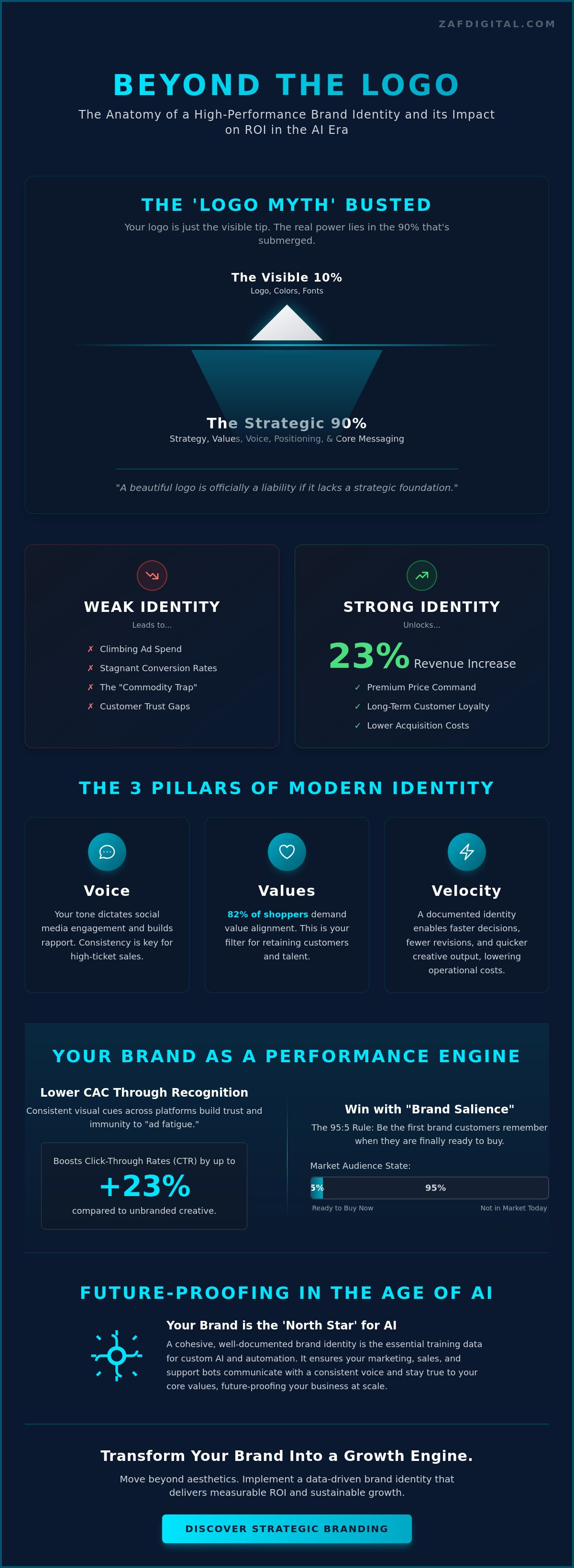
Many founders believe a $500 logo from a freelancer solves their market positioning. It doesn't. In 2026, understanding the real anatomy of brand identity requires looking beneath the surface. True identity is the strategic intersection of visual assets, verbal personality, and core values. It's the source code for your digital marketing; if the code is buggy, your ads, emails, and social posts will never scale effectively.
Think of your identity as an iceberg. The logo is the visible tip, but the 90% submerged represents your strategy and positioning. This depth is exactly why is brand identity important for long-term survival. Without the submerged mass, the tip topples. In a market where 95% of your potential customers aren't ready to buy at any given moment (the 95:5 rule), you need "Brand Salience." This is the psychological shortcut that ensures customers remember your name first when a need finally arises.
To better understand this concept, watch this helpful video:
Why a Visual Refresh Isn't a Growth Strategy
Changing your hex codes without changing your underlying strategy is a waste of budget. We see businesses spend thousands on "rebranding" only to see zero impact on conversion rates because they confused aesthetics with intent. Brand Identity is your internal intent, while Brand Image is the external perception. If they don't align, you create a trust gap. Brand identity is the operating system of your business reputation.
The Three Pillars of Modern Identity: Voice, Values, and Velocity
Voice
Your tone dictates social media engagement. A data-driven B2B firm shouldn't sound like a Gen-Z lifestyle brand. Consistency here builds the rapport necessary for high-ticket sales.
Values
By 2026, 82% of shoppers demand that a brand's values align with their own. Values aren't just posters on a wall; they're the filter through which you hire talent and retain customers.
Velocity
A documented identity allows for faster decision-making. When your creative team knows exactly what the brand stands for, they don't waste hours on revisions. Clear identity equals faster creative output and lower operational costs.
Understanding why is brand identity important starts with moving past the logo. It's about building a predictable, scalable framework that tells the market exactly who you are before you even say a word.
Why Brand Identity is the Secret Engine of Performance Marketing
Performance marketing in 2026 isn't just about bid strategies or algorithmic hacking; it's about who the user recognizes before they even read the headline. A well-defined identity acts as a financial multiplier. It directly impacts your bottom line by slicing through the noise of saturated digital auctions. When users identify a visual language instantly, the psychological barrier to engagement drops. This is exactly the essence of a brand. It's a promise of quality that exists before a single word of sales copy is processed. Partnering with a growth marketing agency allows you to bridge the gap between creative assets and hard conversion data, ensuring that your "look" is actually driving revenue.
Lowering CAC Through Immediate Recognition
High Customer Acquisition Cost (CAC) often stems from a lack of trust. In 2026, the "Rule of 7" has evolved into a more complex digital journey. Users need more touchpoints across fragmented platforms, but those touchpoints only count if they're cohesive. Consistent visual cues across Meta and Google auctions can boost Click-Through Rates (CTR) by up to 23% compared to generic, unbranded creative. This familiarity builds immunity to "ad fatigue." People don't get tired of seeing your brand; they get tired of seeing irrelevant, disconnected ads. Professional social media management services ensure that every post reinforces your authority, making the eventual sales pitch feel like a natural next step rather than an intrusion. This is why is brand identity important for scaling; it makes every dollar spent on ads work twice as hard by reducing top-of-funnel friction.
Identity as a Quality Signal for SEO and Search Algorithms
Search engines now prioritize "entities" over simple keyword strings. Google's E-E-A-T framework (Experience, Expertise, Authoritativeness, Trustworthiness) looks for signals that a brand is a real, trusted authority. Understanding why is brand identity important in this context is vital for organic survival. A unique brand voice and consistent mentions across the web signal to algorithms that you aren't just generating generic content. By 2026, experts predict that 90% of online content will be AI-generated, making a distinct, human-centric identity your most valuable SEO asset. It drives branded search volume, which is a high-intent signal that boosts your overall organic rankings and prevents your site from being buried by "generic AI fluff."
If your current marketing feels like a series of disconnected experiments, it's time to align your visuals with your performance goals. You can audit your growth strategy to see where a lack of identity is costing you conversions.
Myth-Busting: 'Brand Identity is Only for Global Conglomerates'
Many small business owners in the UAE mistakenly view brand identity as a luxury reserved for the likes of Emirates or Emaar. This mindset is a strategic error. In reality, smaller players need a defined identity even more than global giants do. While conglomerates can rely on massive ad spends to brute-force their way into a consumer's mind, a startup must rely on precision. Without a clear identity, you fall into the Commodity Trap. This is a dangerous cycle where, lacking any perceived difference, you're forced to compete solely on price. When you compete on price alone, your margins shrink until your growth plateaus.
A 2023 study by Lucidpress revealed that consistent brand presentation across all platforms increases revenue by 23%. For a niche business in Dubai, this isn't just a statistic; it's a lifeline. A strong identity allows a boutique consultancy in DIFC or a tech startup in Hub71 to dominate a specific segment by appearing more specialized and reliable than a generic corporate giant. It answers the fundamental question: why is brand identity important for those without a million-dollar marketing budget? It's the only tool that levels the playing field by building trust before a single dirham is spent on a sales call.
How Startups Use Identity to Outmanoeuvre Giants
Startups possess a weapon that corporations lack: agility. A bold brand identity allows a small team to take creative risks that would be buried in committee meetings at a larger firm. By building a community-centric brand, small businesses foster loyalty that mirrors the "Micro-Influencer" effect. They don't just sell; they belong. A key part of this is humanizing the brand. Implementing a modern social media video strategy helps startups show the faces behind the logo, creating an emotional connection that a faceless corporation cannot replicate. This transparency turns customers into advocates, driving organic growth through word-of-mouth.
The Cost of 'Invisible' Branding in the UAE Market
In the hyper-visual market of Dubai, being "invisible" is the most expensive mistake you can make. Marketing without a cohesive identity is like pouring water into a leaky bucket. You might generate leads, but if your brand is generic, those leads won't remember you ten minutes later. This lack of recall drives up your Customer Acquisition Cost (CAC) because you're constantly paying to re-introduce yourself. In Dubai’s luxury and tech sectors, a premium identity is the entry fee. It acts as a high-value filter, attracting clients who respect your expertise and repelling those who only seek the lowest quote. If your branding doesn't reflect the quality of your work, you'll never secure the "high-value" contracts that fuel real scalability.
Future-Proofing Your Brand: Identity in the Age of AI and Automation
By 2026, experts predict that up to 90% of online content will be synthetically generated or AI-assisted. In this saturated environment, generic brands will face a "sea of sameness" that kills conversion rates. This reality highlights exactly why is brand identity important; it serves as the unique DNA that prevents your business from becoming a digital commodity. Without a clearly defined identity, your automated systems have no North Star to guide their output, leading to a fragmented customer experience that erodes trust.
Data from a 2024 Intercom report shows that 74% of customers expect an ai chatbot for business to reflect the specific personality of the brand it represents. When your brand identity is robust, it acts as a training framework for these custom models. It ensures that every automated interaction, from a support ticket to a sales nudge, carries the same tone and professional authority your customers expect. We don't just use AI to work faster; we use it to amplify a voice that's already distinct and proven.
Identity as a Filter for Generative Content
Your brand guidelines are no longer just a PDF for designers. They're the prompt engineering foundation for your entire marketing department. By using specific identity markers as constraints, you can ensure that generative tools produce content that feels authentic rather than robotic. This creates a "Brand Guardian" effect where technology serves the strategy. AI should scale your brand, not replace its unique characteristics. This approach maintains a 100% consistent creative output even when producing hundreds of assets daily.
Scaling Personalization Without Losing Personality
McKinsey research indicates that companies excelling at personalization generate 40% more revenue from those activities than slow movers. Identity is what allows you to achieve this 1:1 personalization at scale without sounding like a template. It ensures your brand voice remains unshakable across every touchpoint:
Dynamic Creative
Tailoring visuals to user behavior while keeping core brand elements intact.
Omnichannel Voice
Maintaining the same "soul" whether a customer reads an SMS or hears an AI-generated voice call.
Human Connection
Using a strategic video marketing strategy to anchor your automated funnel with real human faces and stories.
A strong identity ensures that as you automate the journey, you don't automate the "soul" out of your business. It’s the difference between a cold transaction and a lasting partnership.
Don't let your brand get lost in the AI noise. Let's build a future-proof identity together that drives measurable growth.
From Theory to ROI: Implementing a Cohesive Brand Identity with ZAF Digital
Understanding why is brand identity important serves as your foundation, but moving from a theoretical concept to a revenue-generating asset requires a shift in mindset. At ZAF Digital, we don't view branding as an artistic exercise. We treat it as a performance-led strategy designed to fuel your growth engine. Our approach bridges the gap between aesthetics and conversion, ensuring every visual element serves a specific business objective.
We believe that a brand identity only works when it integrates seamlessly with your digital infrastructure. This is why we prioritize high-performance web design as the primary vessel for your brand. A website that looks professional but fails to guide the user toward a conversion is a wasted opportunity. We build sites where the brand identity acts as a silent salesperson, establishing trust within the first 0.05 seconds of a page load.
Aligning Visuals with Growth Marketing Goals
Our "Conversion-First" philosophy dictates that every design choice must be backed by data. We don't open a design tool until we've analyzed your audience's behavior and your competitors' weaknesses. We measure the success of a brand identity through hard metrics. For instance, a cohesive identity can lead to a 15% increase in Brand Search volume and a noticeable reduction in Customer Acquisition Cost (CAC) by improving ad click-through rates. We pair this analytical rigor with cinematic video production to tell stories that resonate emotionally while driving measurable action.
Your Roadmap to a High-Performance Brand Presence
Building a brand that scales requires a structured process. We follow a three-step roadmap to ensure your identity remains relevant through 2026 and beyond:
Step 1: Discovery & Audit.
We analyze your current market position and 2025 performance data to identify gaps.
Step 2: Strategic Positioning.
We define your unique value proposition to ensure you aren't just another "me-too" brand.
Step 3: Creative Execution.
We develop high-impact visuals and messaging that work across all digital touchpoints.
Ongoing brand management is essential as technology evolves. A static brand becomes obsolete. We help you scale your identity alongside your technical infrastructure. If your current branding feels like a "pretty logo" rather than a growth tool, it's time for a change. Book a strategy session with ZAF Digital today to audit your current brand impact and build a roadmap for measurable ROI.
Transform Your Brand Into a High-Performance Asset
The transition into 2026 leaves no room for "just a logo" thinking. Your brand's identity is the central nervous system of your marketing performance, influencing every touchpoint from AI search results to local conversion rates. Understanding why is brand identity important starts with acknowledging its role in building measurable trust. Modern consumers demand consistency. A fragmented identity acts as a leak in your sales funnel. By integrating data-driven creative strategies, you ensure your brand scales efficiently across the UAE's competitive landscape. The region's digital economy is accelerating toward massive growth, and only brands with a clear, data-backed signature will survive the noise.
ZAF Digital specializes in this intersection of creativity and logic. Our Dubai-based team leverages deep UAE market insights to build identities that thrive in an automated world. We don't guess; we use AI-integrated marketing strategies to fuel sustainable growth and clear ROI. It's time to stop treating your brand as a cost center and start treating it as your most powerful performance engine. We're ready to help you build something that lasts.
Scale your brand with ZAF Digital's performance-first identity services.
Frequently Asked Questions
What is the difference between a brand and a brand identity?
A brand is the emotional gut feeling or reputation people have about your company, while brand identity is the collection of tangible elements like logos, typography, and color palettes used to shape that perception. Think of your brand as your reputation and your identity as your uniform. According to the 2023 Edelman Trust Barometer, 71% of consumers say it's more important to trust a brand today than it was in the past. Your identity tools are the specific assets that build this trust visually.
How much should a small business spend on brand identity?
Small businesses typically allocate 7% to 8% of their gross revenue to marketing and branding efforts according to U.S. Small Business Administration guidelines. For a company earning $500,000 annually, this suggests a budget of roughly $35,000 to $40,000 for total marketing strategy. This investment covers everything from initial market research to visual design. While template services exist, professional identity work focuses on long term scalability and market positioning rather than just quick aesthetics.
Can I use AI to create my brand identity?
You can use AI for rapid prototyping and mood boarding, but it can't replace the strategic depth required for a unique market position. Gartner predicts that by 2026, 80% of creative professionals will use AI in their daily workflows. However, AI often generates derivative work based on existing patterns. To stand out, you need a human partner who understands your specific business goals and can inject authentic personality into the data driven insights AI provides.
How do I know if my current brand identity is failing?
You'll know your identity is failing if your customer acquisition costs (CAC) rise by 20% or more while your conversion rates plateau. This often signals a disconnect between your visual message and your audience's expectations. Understanding why is brand identity important becomes clear when your sales team spends more time explaining who you are than closing deals. If your brand recall stats drop below 10% in target audience surveys, it's time for a professional refresh.
How long does it take to see ROI from a rebranding project?
Most companies see a measurable return on investment (ROI) within 6 to 18 months after a rebranding project is fully implemented. Data from Lucidpress shows that consistent brand presentation across all platforms increases revenue by an average of 23%. This growth isn't an overnight event. It's a cumulative effect where improved recognition leads to shorter sales cycles and higher customer lifetime value as your market presence stabilizes and your authority grows.
Does brand identity affect my SEO rankings?
Brand identity impacts SEO through user behavior signals and brand search volume. Google's Search Quality Rater Guidelines emphasize Experience, Expertise, Authoritativeness, and Trustworthiness (E-E-A-T). A strong identity increases your click through rate (CTR) in organic search results. A 2023 study by Backlinko found that pages with higher brand awareness receive significantly more engagement, which signals to search algorithms that your content is valuable and deserves higher rankings.
Why is brand consistency important across different platforms?
Consistency is vital because it takes 5 to 7 impressions for a consumer to even remember your business exists. If your visuals or tone change between LinkedIn and your website, you reset that counter every single time. This is exactly why is brand identity important for scaling businesses. Maintaining a unified presence across platforms prevents cognitive friction and ensures that every digital touchpoint reinforces your professional authority and market reliability.
What are the key elements of a successful brand identity in 2026?
Success in 2026 requires motion-first design, full WCAG 2.2 accessibility compliance, and radical transparency. Static logos aren't enough anymore. Your identity must function seamlessly in augmented reality environments and on high refresh rate displays. Beyond visuals, 64% of consumers now choose brands based on their social and environmental stances. This makes ethical alignment and data transparency core components of any modern identity system that aims for long term growth.