
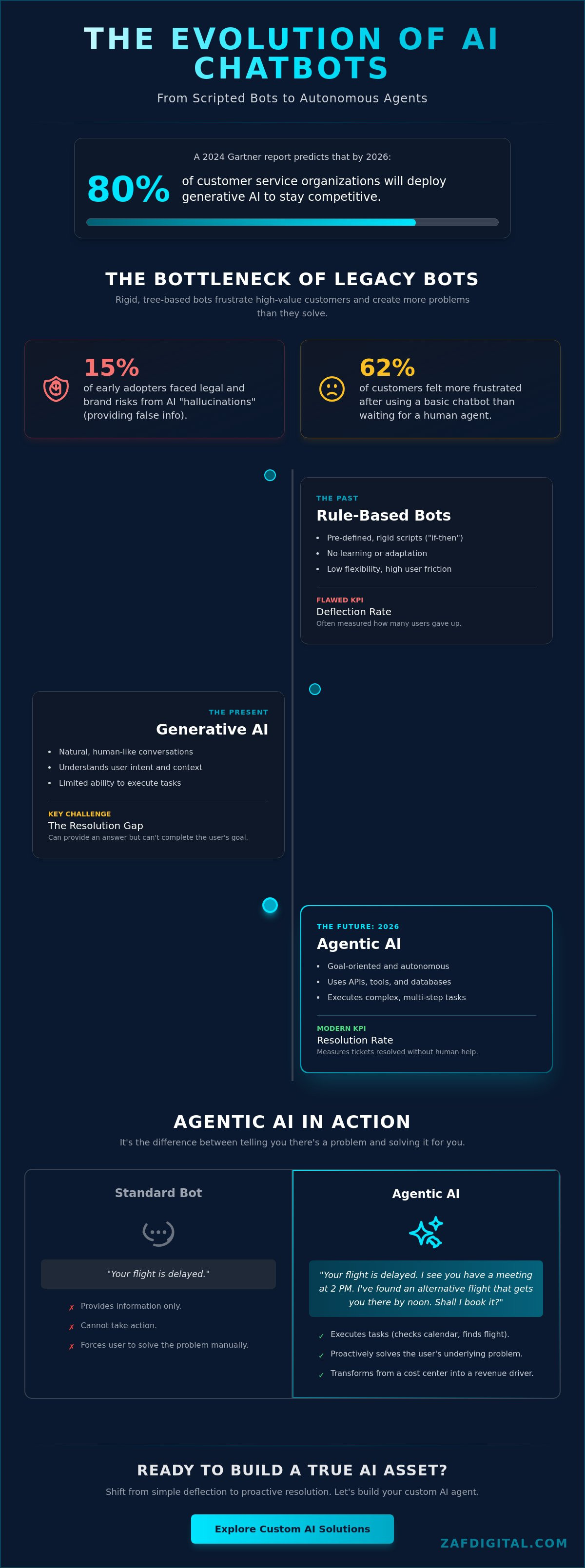
A 2024 Gartner report predicts that 80% of customer service organizations will deploy generative AI by 2026 to stay competitive. You've likely dealt with the friction of a legacy bot that loops through useless scripts while your manual lead qualification costs remain stagnant. It's a bottleneck that prevents real growth. By looking at modern ai chatbot examples, it's clear that the industry has moved beyond simple chat bubbles into the era of autonomous AI agents.
We understand that scaling global support shouldn't feel like an endless drain on your resources or a compromise on quality. This article provides a clear roadmap to identify the right model for your specific industry and explains the critical shift from basic bots to agentic sales tools. You'll explore 12 real-world implementations that prove how data-driven automation drives revenue and simplifies operations for the modern enterprise.
Key Takeaways
• Shift from simple deflection to agentic AI to transform your chatbot from a support cost into a proactive revenue driver.
• Learn how to automate 24/7 lead qualification and mimic in-store personal shoppers to maximize your conversion rates.
• Explore high-impact ai chatbot examples across real estate and healthcare that solve complex industry-specific operational bottlenecks.
• Scale your global reach with autonomous multilingual support and self-service tools that eliminate manual billing and account updates.
• Discover the "Performance First" strategy for building custom AI agents that capture your unique brand voice better than off-the-shelf tools.
The Evolution of AI Chatbots: From Scripted Bots to Agentic AI
Chatbot technology has advanced more in the last 24 months than in the previous two decades combined. To understand the current landscape of ai chatbot examples, we must categorize them into three distinct generations. Rule-based bots started the journey with rigid "if-then" logic. Generative AI followed, bringing natural language capabilities through models like GPT-4. Now, in 2026, we've arrived at Agentic AI, where bots no longer just talk; they execute complex business processes autonomously.
The metrics for success have shifted alongside this technology. For years, companies focused on "deflection" as their primary KPI. This was a flawed approach because it often measured how many users gave up rather than how many were helped. Modern businesses in 2026 have abandoned deflection in favor of the Resolution Rate. If a bot cannot resolve a ticket from start to finish without human intervention, it's considered a legacy cost rather than an asset. The Evolution of AI Chatbots shows that while early systems like ELIZA were mere curiosities, today’s systems are core drivers of ROI and operational scaling.
To better understand how these modern systems function in a real-world environment, watch this helpful video:
The Problem with Legacy Chatbots
Rigid, tree-based bots built on 2018-era technology frustrate high-value customers by forcing them through narrow paths. A 2024 Gartner study revealed that 62% of customers felt more frustrated after using a basic chatbot than if they had just waited for a human. Early generative models tried to fix this but introduced "hallucinations," where the AI confidently provided false information. This created significant legal and brand risks for 15% of early adopters. The "Resolution Gap" is the measurable disparity between a chatbot providing a relevant answer and successfully completing the user's intended transaction or workflow.
What is Agentic AI in 2026?
Agentic AI represents the third generation of ai chatbot examples. These agents don't just answer questions; they use tools, browse internal databases, and execute workflows. A standard bot might tell you your flight is delayed. An agentic bot sees the delay, checks your calendar, finds a new flight, and asks if you want to book it. This shift relies on long-term memory and context. By 2026, 70% of B2B interactions involve agents that remember a customer's history across multiple platforms, turning every interaction into a continuous relationship rather than a one-off ticket.
Rule-based
Pre-defined scripts, no learning, low flexibility.
Generative
Conversational, understands intent, but limited action.
Agentic
Goal-oriented, uses APIs, executes multi-step tasks.
Sales and Marketing AI Chatbot Examples
In 2026, sales bots have evolved from simple greeting tools into high-performance revenue drivers. They don't just answer questions; they actively move prospects through the funnel by mimicking the nuances of a human sales representative. These ai chatbot examples demonstrate how automation directly impacts the bottom line by removing friction from the buyer journey.
Lead Qualification and Nurturing
AI chatbots function as your high-performance SDRs that never sleep. A B2B software firm recently reported a 40% increase in qualified leads after deploying a bot that scores prospects based on conversation depth and intent. Instead of static forms, these bots engage users in dynamic dialogue. They identify high-value targets by asking specific budget and timeline questions, ensuring your sales team only focuses on "warm" handoffs. You can sync these interactions directly with HubSpot or Salesforce to maintain a clean data pipeline. For a deep dive into the technical setup, check out this guide on Custom AI Chatbot Development for Business.
Conversational Commerce
Modern e-commerce bots act like digital personal shoppers. They don't just show products. They offer style advice, handle sizing queries, and process payments in real-time. By early 2026, voice-activated AI pushed mobile shopping conversion rates up by 15% compared to traditional touch interfaces. These bots can also trigger time-sensitive 10% discounts during a chat to close a sale immediately. When Building Your Custom AI Chatbot, integrating real-time inventory and CRM data is essential for providing accurate, stock-aware recommendations. This level of personalization turns a casual browser into a repeat customer.
Beyond simple product suggestions, AI handles the logistics of the sale. Automated appointment scheduling is now a standard feature, with bots syncing to Google or Outlook calendars in real-time to book demos or consultations. This eliminates the back-and-forth of email threads that often kills deal momentum. For retail brands, conversational AI solves friction at the most critical point: the checkout. If a user pauses on the payment page, the bot proactively asks if they have questions about shipping or returns. This specific intervention recovers 22% of abandoned carts that would otherwise be lost to competitors. If you're ready to start scaling your revenue with these tools, the technology is more accessible than ever.
Effective ai chatbot examples in the marketing space focus on one thing: speed. Whether it's qualifying a lead in 30 seconds or offering a personalized discount while the intent is high, these tools ensure you don't leave money on the table. They turn your website from a static brochure into a proactive sales machine that works around the clock.
Customer Support and Operational AI Examples
By 2026, the distinction between a "bot" and a "digital colleague" has blurred into irrelevance. Modern ai chatbot examples in the support sector show a decisive move toward total autonomy for routine tasks. Instant multilingual support now allows a mid-sized e-commerce brand to serve 50 countries without hiring 50 different language teams. These systems use real-time neural translation to maintain brand voice while resolving technical issues in over 100 dialects simultaneously. This capability has effectively removed the language barrier as a hurdle for global scaling.
Self-service account management has evolved far beyond simple password resets. Today, bots handle complex billing updates and subscription migrations by directly interacting with secure backend databases. This level of integration is why the primary AI chatbot benefits focus on massive operational efficiency; businesses can now redirect human talent toward high-value strategy rather than repetitive data entry. According to a 2025 industry report, companies implementing these autonomous systems resolved 92% of account-related issues in under two minutes, significantly outpacing human-only teams.
Internal operations also see a massive shift. AI functions as a 24/7 HR and IT helpdesk, onboarding new employees by guiding them through tax forms, hardware requests, and security permissions. Data from 2025 indicates that companies using AI for onboarding see a 33% faster time-to-productivity for new staff. Instead of searching through fragmented folders, employees ask an internal bot to find specific policy details or technical documentation in seconds.
The High-Resolution Support Model
Leading airlines now deploy bots capable of rebooking flights and processing refunds autonomously during mass weather delays. By early 2025, these systems reduced support ticket volumes by 70% while increasing CSAT scores by 12 points. While the AI handles the bulk of the work, a "human-in-the-loop" protocol remains essential. If a passenger reports a medical emergency or a high-stakes travel crisis, the system triggers an immediate escalation to a senior agent, ensuring empathy is present where it matters most.
Internal Operations and Knowledge Management
AI chatbots serve as internal search engines for company wikis, turning static documents into interactive knowledge hubs. They automate repetitive data entry tasks through conversational interfaces, saving the average employee 5 hours per week. At ZAF Digital, we optimize internal workflows by deploying AI that connects siloed data. This ensures every team member has instant access to verified project histories and technical documentation without manual searching, driving a culture of data-driven transparency and speed.
Industry-Specific AI Chatbot Use Cases for 2026
Generic bots are a liability in a market that demands precision. High-performing organizations now deploy vertical-specific solutions tailored to their unique regulatory and operational needs. These ai chatbot examples demonstrate how specialized logic drives measurable growth across different sectors.
Real Estate Automation in the UAE
Dubai's property market operates 24/7, serving investors across 12 different time zones. Waiting six hours for a broker to wake up results in a 40% drop in lead conversion. AI bots now automate the "First Response," achieving a 0-minute lead response time. These systems don't just capture emails; they conduct virtual property tours and process rental applications through secure portals. If you want to scale your operations without doubling your headcount, check out our AI Chatbot for Business: The Ultimate Strategic Guide for a deeper dive into deployment strategies.
Healthcare providers use AI to solve the bottleneck of patient intake. Bots now handle patient triaging by asking targeted diagnostic questions, which has been shown to reduce administrative workloads by 22% in clinical settings. These systems operate with full HIPAA compliance, ensuring that sensitive patient data remains encrypted while sending automated appointment reminders that reduce no-show rates by 30%.
FinTech and Secure Banking
Modern banking bots have moved beyond simple balance inquiries. They now provide personalized investment insights by analyzing spending patterns in real-time. Security is the foundation here. Conversational banking in 2026 relies on biometric authentication, using voiceprint and facial recognition within the chat interface to authorize high-value transfers. For UAE-based financial institutions, data residency is a critical requirement; all AI-processed financial data must reside on local servers to comply with Central Bank regulations and NESA standards.
Luxury retail brands are using VIP concierge bots to maintain exclusivity for high-net-worth individuals. These bots recognize top-tier clients instantly, offering early access to limited collections and coordinating private viewing sessions based on past purchase behavior. As these ai chatbot examples prove, the value lies in the data-driven execution. This isn't about cost-cutting; it's about providing a frictionless, 24/7 white-glove service that human teams cannot maintain at scale.
Ready to move beyond basic support and start driving revenue? Partner with ZAF Digital to build an agentic AI strategy that scales your business.
Building Your Custom AI Chatbot: The ZAF Digital Approach
Most ai chatbot examples you find online are generic, off-the-shelf templates. They might answer basic questions, but they fail to capture your unique brand voice. At ZAF Digital, we reject the "one size fits all" model. Our "Performance First" strategy ensures every AI interaction moves the needle toward revenue. We don't build bots to simply answer FAQs; we engineer agentic sales partners designed to close deals. By 2026, 85% of customer interactions will be AI-driven. If your bot sounds like a machine, you're leaving money on the table.
An AI agent shouldn't exist in a vacuum. It must be woven into a high conversion web design framework. We sync your AI with your site’s UX to create a frictionless journey from landing page to checkout. We track the revenue impact of your AI agent through granular metrics. Instead of vanity numbers like "chat volume," we focus on lead-to-close ratios and customer lifetime value (CLV). Our data shows that agentic sales bots can boost conversion rates by 22% compared to traditional static forms.
Custom Development vs. SaaS Platforms
SaaS platforms like Intercom are excellent for basic support, but they have limits. Custom development offers a level of precision that SaaS cannot match. When you build a proprietary model with ZAF Digital, you own your data and your infrastructure. SaaS fees often scale with your success, becoming a massive liability over time. Owning your AI infrastructure can reduce operational costs by 40% over a three-year period. We act as your strategic partner, guiding you through this AI transformation to ensure your technology remains a competitive asset, not a monthly bill. These ai chatbot examples prove that ownership leads to better long-term ROI.
Next Steps for Your AI Transformation
Success starts with a clear roadmap. We begin with an AI readiness audit to identify bottlenecks in your current sales process. We don't ask you to go all-in on day one. We launch a 90-day Pilot Program to prove ROI through measurable data before scaling. This "no-bullshit" approach ensures transparency and results. You'll see exactly how the AI impacts your bottom line before we expand its capabilities. It's time to move beyond basic automation and embrace agentic sales. Book an AI Strategy Session with ZAF Digital today to start building your custom growth engine.
Scale Your Revenue with Agentic AI Systems
The transition from scripted bots to agentic AI represents the most significant shift in business operations for 2026. These ai chatbot examples prove that automation is no longer a simple support tool; it's a core driver of revenue and operational precision. Gartner research indicates that 80% of customer service organizations will integrate generative AI by 2025 to handle high-complexity tasks. In a region where the UAE National AI Strategy 2031 aims for a 14% contribution to the national GDP, settling for basic automation isn't an option. You need intelligent systems that act autonomously to solve problems and close sales.
ZAF Digital bridges the gap between complex technology and measurable business growth. As Dubai-based AI experts, we specialize in delivering custom-built, agentic AI solutions that offer proven ROI in the UAE market. We don't just provide software; we engineer strategic assets that integrate seamlessly with your workflow. It's time to stop managing manual processes and start leading your industry with superior technology. Automate your growth with a custom AI chatbot from ZAF Digital today. Your business is ready for the next level of efficiency.
Frequently Asked Questions
What are the best AI chatbot examples for e-commerce in 2026?
The most effective ai chatbot examples for e-commerce include Shopify's Sidekick and Klarna's AI assistant. Klarna reported in 2024 that its AI handled the workload of 700 full-time agents while maintaining high customer satisfaction. These tools don't just answer questions; they manage complex returns and personalize product bundles using real-time inventory data.
Can an AI chatbot really replace a human sales representative?
AI chatbots won't fully replace human reps, but they handle 80% of routine qualification and support tasks. Gartner predicts that by 2026, AI deployments will save businesses $80 billion in labor costs. Your sales team can focus on closing high-value deals while the agent qualifies leads and schedules meetings 24/7 without fatigue.
How much does it cost to develop a custom AI chatbot for a business?
Custom AI chatbot development costs vary based on complexity and integration requirements. Industry benchmarks from 2024 suggest that enterprise-level solutions typically range from $10,000 to $150,000. These figures include data training, API integrations, and security compliance audits. Maintenance usually adds another 20% to the annual budget for performance tuning.
Are AI chatbots secure for handling sensitive customer data?
AI chatbots are secure when built with enterprise-grade protocols like SOC2 Type II and GDPR compliance. Modern systems use 256-bit AES encryption to protect customer data during every interaction. According to IBM's 2024 report, companies using AI-driven security automation saved $1.76 million on average during data breach incidents compared to those without it.
What is the difference between a chatbot and an AI agent?
A chatbot responds to queries based on scripts, while an AI agent autonomously executes tasks to reach a goal. Agents use agentic workflows to browse the web, update your CRM, or process refunds without human intervention. This shift represents the evolution of ai chatbot examples from simple text boxes to proactive digital employees.
How do I integrate an AI chatbot with my existing CRM?
You integrate an AI chatbot with your CRM using REST APIs or native connectors found in platforms like HubSpot and Salesforce. Most modern systems offer no-code integration hubs that sync lead data in real-time across your stack. Statistics show that 74% of high-performing sales teams use CRM-integrated AI to maintain perfect data hygiene.
Which industries benefit most from AI chatbot automation?
E-commerce, financial services, and healthcare see the highest ROI from AI automation today. A 2025 industry study showed that retail brands reduced response times by 90% using AI. Banks use these tools to process 60% of basic loan inquiries, while healthcare providers use them to automate 45% of patient scheduling tasks.
How do I prevent my AI chatbot from giving wrong information?
You prevent hallucinations by using Retrieval-Augmented Generation (RAG) to ground the AI in your verified company documents. This technique restricts the AI to your specific knowledge base instead of letting it guess answers. Implementing a human-in-the-loop review process for 5% of flagged conversations ensures the system remains 99% accurate as your data evolves.